
The Bear Season 2
Even better than the first season

This piece was written during the 2023 WGA and SAG-AFTRA strikes. Without the labor of the writers and actors currently on strike, the series being covered here wouldn't exist.
It can be hard to build dramatic momentum in sequence, hard to follow up a seemingly or truly special media phenomenon. But The Bear, in season two, seems to have done just that. It expands on the interior lives of the cast, moves the plot forward while filling in backstory, continues to ably combine the serial-episodic with the prestige-dramatic, and remains the perfect dramedy showcase for the restaurant industry.
To that effect, there’s a tension I’ve been grappling with which I see refracted from the days of Anthony Bourdain’s Kitchen Confidential. When I read the book, I started reminiscing about my time as a pizza chef, working on a line, combined with my time waiting tables and bartending, and even considered going to culinary school – not in a serious way (once I saw the prices and considered existing loan debt) but in the wistful way we consider things when between jobs and swept up in the passion of a good book, such as one of the most well-known culinary memoirs of all time. The tension is a reflection of that passion – can you depict the hard work of operating a restaurant without either demonizing the venture or, more pressing in the avenue of fiction which requires triumphant arcs for catharsis, lionizing all the parts of it that destroy people? That might not be worth pulling your hair out about, but it might be worth considering.
If art has social responsibility (a big IF that comes close to flirting with moralism), does it extend to the air that we grant small business tyrants? It’s possible to read a piece without reading morality or politics into it, but even art which isn’t trying to say anything moral or political is still speaking, by the nature of its being. And The Bear says a lot, enough that celebrity chef Rick Bayless worries it glorifies a certain dysfunctional style of restaurant management. The transformation that takes place over the course of the season – of the characters and the restaurant world around them – is in conflict with this assessment. In reading his comments I couldn’t help but think about my experiences in different restaurants, and the near-end chapter of Kitchen Confidential where, after telling stories about his experiences in punk rock-pirate kitchens, Bourdain talks about his experience visiting a calmer, cooler, more collected style, an eye-opening experience for the reader wherein Bourdain humbly allows a rebuttal or counter-argument to everything he’d put forth before.
One of my first thoughts after watching the first season of The Bear was about whether cooking shows generally (like the many short-form docuseries on Netflix that lovingly appraise street food traditions across the globe) or The Bear in particular have any affect on culinary school applications (the way NCAA Final Four and football bowl appearances are alleged to have affects on university applications; for my part, The Bear’s first season did not make me hunger to be back in that line of work so much as polish my skills at home and try to make deep dish pizza). What The Bear is selling as much if not even more than the beauty and hardship of working in restaurants is Chicago, artfully displayed in wide shots, overhead pans, and montages, the combination set to music which combines with this photography to provide a retrospective feel, sometimes bordering the surreal but generally relating a vibrancy that almost seems to parody city tourism board advertisement. It is people, driven but sometimes unfocused, with differing talents and varying skill levels, with struggles and conflicts and ticks and idiosyncrasies; flawed, real humans. It is food, so much food, cuisine lovingly depicted – built and captured like artwork while showing the human machinery that makes it so; food is here busts, statues, architecture of flora and fauna and water and minerals (maybe I’m paraphrasing The Menu here), combinations of cultural experiences and the inspiration of life’s triumphs and trauma.
The Bear was created by Christopher Storer. Storer directed 12 out of 18 episodes between two seasons; co-showrunner Joanna Calo did five and Ramy Youssef did one (episode four of season 2, “Honeydew”). Storer shares writing credit with story editors Karen Joseph Adcock and Sofya Levitsky-Weitz, staff writers Catherine Schetina and Alex O’Keefe, and Joanna Calo, Rene Gube, Kelly Galuska, Stacy Osei-Kuffour, and Alex Russell. Music is handled by J.A.Q. (all 18 episodes) and Johnny Iguana (10 episodes in the second season). Andrew Wehde handles the lion’s share of cinematography (15 episodes), joined by Adam Newport-Berra (season 1 pilot “System” and season 2’s “Honeydew”) and Chloe Weaver (second unit D.P. on The Menu, she is responsible for season 2’s third episode, “Sundae”). Joanna Naugle (12 episodes) is joined by Adam Epstein (7), Nia Imani (“Sundae”) and Megan Mancini (season 2, episode 8 “Bolognese”) in the editing department. Jeanie Bacharach (all 18) and Maggie Bacharach (all of second season) handle casting. Sam Lisenco did production design for the pilot, Merje Veski has done the rest; Eric Dean did art direction for the pilot, Lisa Korpan did the rest; Cristina Spiridakis designed costuems for the pilot, Courtney Wheeler did the rest. There’s also a decent sized makeup department led by Ignacio Soto-Aguilar, Ally Vickers (hair department head), Nicole Rogers, and Justine Losoya, and including Rochelle Uribe, Heather Napolitano, Melissa Musseau, Randy Wilder, and Anna Zenner. That’s a lot of names; you could have just gone to IMDb; I am putting them here because I believe that Christopher Storer leads this party, and Joanna Calo (who has written, directed, and is credited as executive producer alongsider Storer on every episode) is probably the next important, but it takes a village to make a TV series. Storer’s sister Courtney serves as the culinary producer of the show, helping add to the authenticity through her own experience and skill.
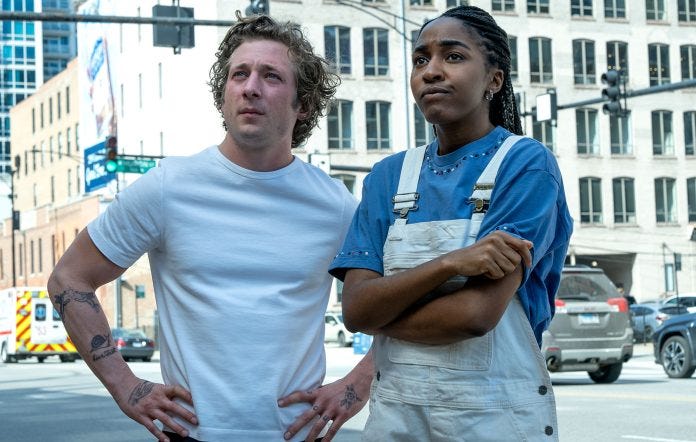
The Bear follows Carmen Berzatto (AKA Carmy, I thought it was going to be Carmine and was surprised it was not, played by Jeremy Allen White) as he takes over his family’s restaurant after his brother (Jon Bernthal) commits suicide; he is helped in large part by his play-cousin/informally-adopted-brother Richie (Ebon Moss-Bachrach), fellow crashed-and-burned culinary school graduate Sydney (Ayo Edibiri), baker-turned-pastry chef Marcus (Lionel Bryce), and hardass kitchen matriarch Tina (Liza Colón-Zayas). Abby Elliot plays his sister Natalie (AKA Sugar) seemingly well-adjusted, married to a swell albeit dorky guy (Chris Witaske as Pete), and always looking out for everyone with best intentions, sometimes to a fault, who is eventual project manager of the restaurant rebuild. Real life chef Matty Matheson plays Neil Fak, another family friend and their restaurant handyman. Oliver Platt plays Uncle Jimmy AKA Cicero, family friend and well-connected local business owner.
The Bear is not short on star turns, but everyone is working within the idealized brigade, sticking to their station and filling in elsewhere as needed. The Bear does an excellent job demonstrating growth in character without being too neat or saccharine. While the brilliance of both Sid and Marcus has doubled edges, it’s Richie whose arc brings him from a frustrating if well-meaning asshole to meaningfully a core of the team, while Tina is probably my favorite character.
The first season coalesces around a tremendous monologue by Carmy in group therapy, around his relationship to his brother and his family and how that relates to his cooking. The season culminates in a penultimate episode where all the tension and problems built up over the season come to their various heads in an explosive meeting. The second uses a similar stress-filled episode – this time the longest o the season rather than the shortest – to fill in backstory and plant more things to pay off. In a season dotted with phenomenal guest performances, episode 6 of season 2 (“Fishes”) combines several for a tremendous and delectable smorgasbord of familial dysfunction taken past logical ends to the sensational but believable apexes of television. So much is elucidated and uncovered, laid for picking as well as laid bare.
The Bear understands tension and anxiety and spectacle. It still understands that it’s television, so it must entertain and – like most creative pursuits – it involves some shortcuts and magic tricks. There is certainly a bit of straining credulity in the ways people advance over the course of this second season, and the final accidental confrontation only happens because of circumstances that should be impossible, but this reflects the conflict and themes at play, so it works. The Bear quiets questions about what’s feasible or plausible with enlivening performances of tense, exhilarating, and occasionally inspiring writing. By utilizing the short amount of episodes to cover a decent amount of time, montage and cut-outs help convey the feeling that a lot of life is taking place for each of the individual characters. The team is growing as the individuals grow and the audience shares experiences with each character that they don’t share with one another, but they also experience things individually and with one another that the audience doesn’t see. This is a treacherous path to walk, a high-wire act as it were, because it creates potential for making too many important things happen away from the camera. Storer and co. are successful in utilizing this to the affect that the viewer gets a sense of being granted a fleeting gift of time with these characters, watching them take on incredible, albeit grounded, challenges.
In the first season, Carmy erupts at his staff because of the unfocused talent and ambition which allows long-developing interpersonal tensions on the job site to explode and turn a day of restaurant operations into a worse hell than usual. In the second season, as his own focus shifts from the restaurant into his personal life, he feels he’s failed his team. Ironically, while he’s literally locked in a fridge, he’s given them the tools to succeed without him – Tina’s short time at culinary school helped her hone her skills and be an excellent sous chef for Syd, who was always ready to be an excellent chef de cuisine; Marcus’s time in Copenhagen helped him develop his pastry chefs to the edge of his talent; Richie’s brief stage (an unpaid internship that restaurants are far too reliant upon) at a restaurant Carm used to work at has taught him the importance of precision and anticipation; and his pregnant sister project manager Natalie jumps in to help with plating. Against all odds, they manage the very live dress rehearsal of friends-and-family night without a hitch that would show on the dining floor. He’s self-destructing in the walk-in, eventually venting some things he didn’t want his girlfriend to hear, then exploding at Richie for calling him out for his vicious anxiety-driven acerbic tongue. For at least one night, they’ve proven they can do without him, but his fear of failure and his deep self-loathing turn victory into defeat. It’s just tremendous television, and it does something I think is very important to do in TV – make every season finale feel like it could be the series finale, because it might be. Give us something to walk away with, but leave us wanting more.
I still think The Bear would have been better served to stretch out the release on a week-by-week basis because of the way that allows more time to engage with and even dominate conversation in publications and on social media, instead of just being fodder for bad takes about fandoms and shipping. Nonetheless, it’s a potent enough show with a hot enough cast that it’s staying in people’s minds, even if the Emmy’s voters weren’t won over.
The Bear isn’t modest, exactly; neither demure nor taciturn, nor unsure of itself. There’s a brashness to it and a swaggering confidence. The Bear exemplifies the potential of its medium. There are good half-hour comedies and good forty-five minute dramas and good miniseries that feel like extended movies. And there are bad examples of all these applications of these media as well. The Bear has traits of all of the good but never feels like it would be better off in some other format, even with one hour-long episode in the mix. Its interest in drama, in romance, in grief and family trauma and the pursuit of greatness and the ways ambition and patience are so often at odds fit its form so well. The economy of storytelling in the second season provides the feeling that things are happening offstage away from the camera, so you know a few conversations were had and decisions made away from view of the audience.
And yet, the things audiences eyes have been on remain vital – the show is forcing focus on specific places to express this very human difficulty of not being able to be everywhere at all times and be everything for all people. What’s more, when you fear you might have missed something, it might have been skipped over, it’s revealed that, no, sometimes decisions that should have been made were not, that as time ticks on and slips away a person can find themselves frozen, and people around them can pay for it. The Bear season two is insistent that every second counts, and devotes its time to showing how true that feels in the restaurant world, where intrepid entrepreneurs, brilliant culinary minds, creative artists, reliable craftspeople, attentive service staff, all come together in an attempt to make elevating dining experiences, and through the combination of structural factors erected which they must navigate, they can be crushed by their missteps, or find temporary, hollow, and generally Pyrrhic victories. The Bear is about the difficulty of keeping one’s eye on the ball, and what happens when that ball can’t be identified, about the fragility of balance, about all the ways love can exist in a family and a restaurant, and maybe all the ways bitterness and resentment can too.